
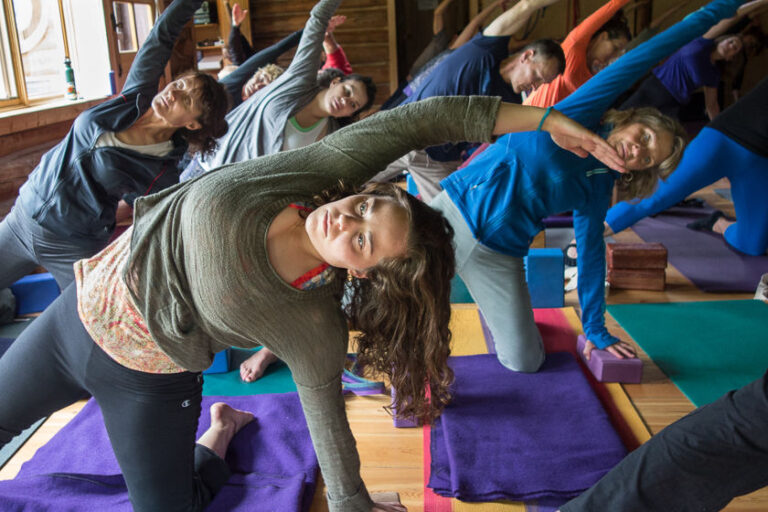
As yogis, many of us know the power of our practice to support our body, mind and spirit. But how well do you understand your nervous system? Are you optimizing the opportunity to increase its adaptability?
Consider your inner state… do you often feel on edge or overwhelmed? Do you have supportive practices to help you settle and unwind, or do you find yourself turning to other forms of comfort or distraction?
Many of us spend a lot of time in states of heightened arousal, where the demands of daily life keep the sympathetic nervous system (SNS) more active than we’d like. The SNS is a branch of the autonomic nervous system that is like the gas pedal, helping to mobilize the body for action. It increases heart rate and breathing, redirects energy toward muscles, and helps prepare us to meet a challenge or perceived threat.
Moving us in the opposite direction is the parasympathetic nervous system (PSNS), which is like the brake pedal. It slows heart rate, supports digestion, and redirects energy toward restoration and recovery.
Both of these branches are always active, running the “engine” that is our body — we need both to survive.
However, many of us have become used to running our engine on overdrive. We’re in a stressed state, but don’t even realize that we’re in it, much less how to return to center. Wired and tired becomes our new normal. It doesn’t serve us to always be hyper-aroused — in this stressed or anxious state… But we also don’t want to live on the other end — disconnected or shut down.
Ideally, we could spend most of our days within what’s called the “window of capacity” (essentially homeostasis) — a range where our nervous system is adaptable and adequately responsive to our environment. Within this window, we can move between greater activation when life asks more of us, and greater ease when we have space to rest. We can meet challenge without moving beyond our threshold into a survival response — upward into “Fight or Flight” or downward into “Freeze or Collapse.”
So… how “flexible” is your nervous system? And what can you do to support it?
Practices that Support Adaptability
Our brains are capable of changing in response to repeated experience — an ability known as neuroplasticity. In short, not only can the brain reorganize, like re-learning to walk or talk after a stroke, but we can deepen existing neural pathways and even create new ones with repetition, like becoming better at playing a musical instrument through practice. (However, any repetition, or habit, “good” or “bad” can strengthen its own pathways… so it’s important to discern which practices and habits serve us best.)
To be effective, our practice needs to be consistent (repetition). And we need to vary the experience, incorporating practices that challenge and stress us, and those that invite stillness and relaxation.
Recall the sutra Sthira-Sukham Asanam, “The posture should embody both steadiness and ease.” We can expand this concept of balance into our practice regimen as well, and let it guide us to optimize our nervous system’s adaptability.
A strong asana practice eases onto the gas pedal, and invites us to meet challenge with steady, alert presence.
A supportive restorative class gently applies the brakes, creating space for deep rest and recovery.
One is not better than the other. We can utilize both to practice moving the nervous system between activation and ease — like a dimmer switch, sliding brighter and darker. The more consistently we shift within our window of capacity without surpassing its thresholds, the more potential we have to support adaptability.
This doesn’t mean we’ll be calm all the time, and never get pulled beyond our threshold and get overwhelmed — that isn’t realistic… we won’t always stay within that window. And, that’s not the goal. Life will challenge us.
Instead, can we become more adaptable? Can we establish practices that support this unique type of flexibility — allowing us to meet challenges with activation and strength, and then return to ease and center when the challenge has passed?
This fluidity invites us to reflect on our inner state, meet the present moment with greater clarity, and find our way back to center again and again.
Savasana: A simple practice for deep relaxation to support your nervous system.
Whether you’re familiar with practicing a shorter resting pose at the end of a flowing yoga practice, or you’ve never heard of “Savasana,” give this longer rest a try. Start with 10 minutes if that feels more accessible, and gradually build toward 20. Notice any shifts you experience during and after your restorative practice.
(A note: we need to feel safe in order to relax. If relaxing feels like a threat, we will not be able to invoke the relaxation response that we’re after. Consider what makes relaxation feel safe for you.)
— Set aside 10-20 minutes. Find a quiet place where you can avoid interruptions.
— Put your phone on silent, and set a soothing sound for your timer.
— Put down a mat or blanket, or lie on your couch or bed.
— Under your head and neck: Add a pillow or folded blanket, so your chin is slightly tucked.
— Under your knees: Add a pillow or rolled blanket, so your knees and hips are gently flexed.
— Cover your body with a blanket.
— Cover your eyes with an eye pillow or washcloth, or if you prefer your eyes open, dim the lights and let your eyes settle on a soft gazing point.
— Position all props so that you are deeply comfortable.
— Take a slow, easy breath in, and let the exhale lengthen. If it feels natural, let out a soft sigh.
— Rest until the timer invites you to complete your practice.
Notice how you feel afterwards. What has shifted? Does it affect the rest of your day?
*Featured image credits: Zane Williams
~~~~~~~~~
Curious to explore this balance of ease and strength through yoga? This September, Britni Serou joins Annie Carpenter at Feathered Pipe for the first time to bring the renowned SmartFLOW methodology to this beautiful Montana setting. Together, we’ll explore both flowing and restorative practices, creating space to reconnect with your body, your breath, your teaching, and the quiet wisdom that arises when strength and ease meet. Join us September 12 – 18, at the Ranch for Balancing Strength & Ease: A SmartFLOW Yoga Retreat.
~~~~~~~~~
About Britni Serou:
 Britni Serou is the co-founder of Downtown Yoga in Hammond, Louisiana, and has been teaching yoga for over 20 years. She found her home in yoga through Annie Carpenter’s SmartFLOW method while training in Los Angeles in 2011, and now serves as Annie’s lead Teacher Trainer—offering 200- and 300-hour trainings locally and internationally alongside her mentor.
Known for classes that are both challenging and accessible, Britni teaches with precision, playfulness, and deep care—inviting students into inquiry, subtlety, and self-expression. Her background in art and design informs a creative and balanced approach to sequencing and teaching, while her appreciation for stillness and the natural world fosters a grounded, nurturing space for practice.
Britni believes yoga is a path of seeing clearly—understanding our patterns of thought so we can relate to ourselves and others with greater awareness and compassion. She especially loves teaching mentorship, restorative practices, and yoga philosophy, sparking meaningful connection and insight both on and off the mat.